Relational infrastructure in action: the Zero Carbon Cumbria Partnership
In your work, do you focus on persuading people? Or do you prefer to work with those who are convinced?
We need both. But lately, I’ve loved the energy and solidarity that come from people who are already convinced.
The work becomes less about direct persuasion, and more about supporting one another to persuade others, helping each other do our work better, and connecting each other with the relationships and resources we need to keep going.
Maggie De Pree pointed me to the phrase “relational infrastructure”: the work of helping people to connect. [1]
Last month, I got to see this live and up close. The Zero Carbon Cumbria Partnership is a partnership of more than 80 organisations across the northern English county of Cumbria, chaired by Karen Mitchell and David F Murphy, managed by Futureproof Cumbria (of which I’m a trustee), originally funded by The National Lottery Community Fund and now Westmorland and Furness Council.
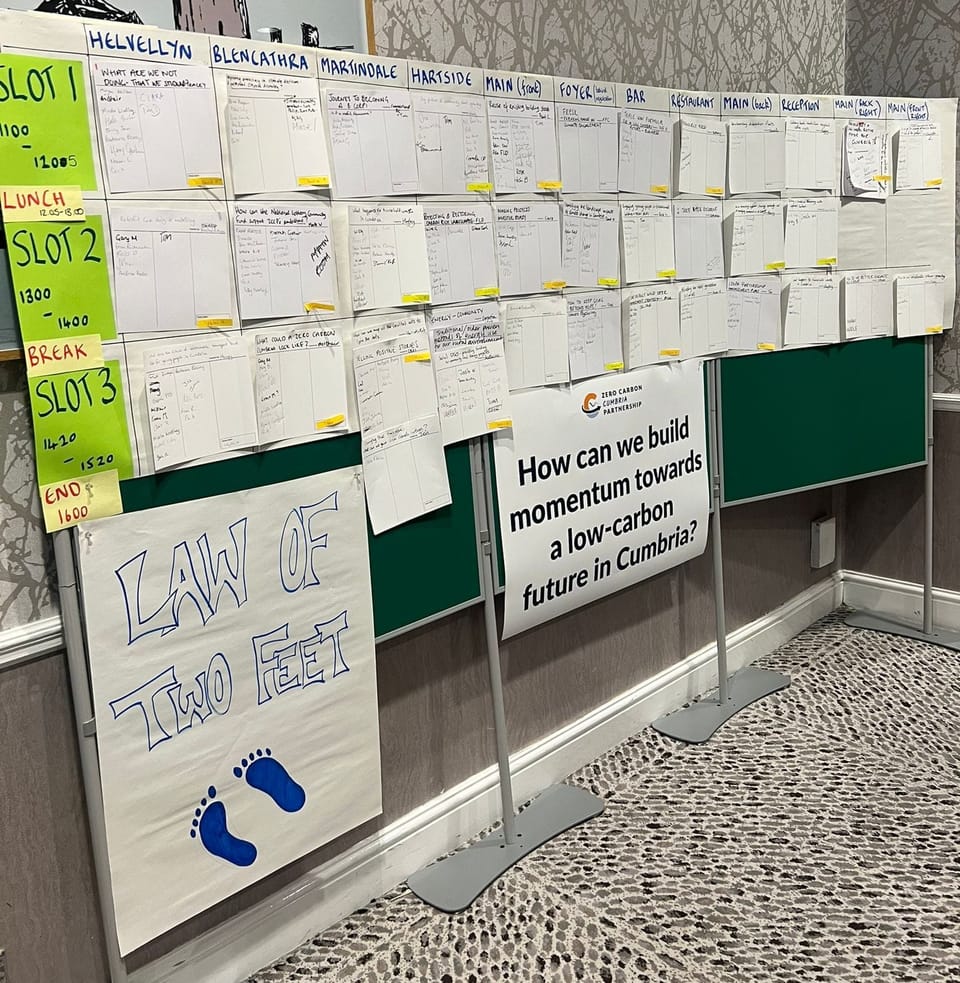
This year's ZCCP summit took the form of an unconference: a participant-created agenda, reflecting the ZCCP's mosaic of community-led climate action across the public, private, voluntary, and community sectors.
No advance agenda, no keynotes, no panels: instead, people showed up, put their hands up to host sessions, and off we went (excellently facilitated by Rhuari Bennett and "The Law of Two Feet").
The 30+ discussions ranged from community food growing and renewable energy, to sustainable transport for young people, to the Lake District National Park’s wild deer and venison strategy, to growing the Cumbrian B Corp community.
And conversations about how change happens, and how to turn climate anxiety into hope.
I overheard:
→ A leadership development programme manager, an architect, and a graduate figuring out how to promote apprenticeships in green and traditional building skills
→ An energetic salesperson pitching electric chainsaws and tractors to a major local land manager
→ A secondary school student, a researcher in gender and climate justice, and local councillors brainstorming strategies to elect a climate-positive mayor… followed by concrete next steps.
It’s easy, especially in funding, to focus on what’s visible: projects with easily measurable and attributable outcomes. These matter. But it might be that they exist because someone first spent years building the infrastructure that lets people find each other, and grow the trust and shared momentum that make action both possible and sustainable.
As Kenneth Bailey and Keller Easterling write, relational infrastructures “can make something from almost nothing in a way that benefits many… It is no different from planting one seed and getting ten.” [2]
Staying with the metaphor: Relational infrastructure is the soil. For those of us funding, designing, or supporting change, we can ask ourselves: Where do the seeds of action exist? What do they need to grow? And how do we keep that relational soil healthy so the roots can hold?
An un-conference still needs considerable organising and facilitation! Many congratulations to everyone who put so much work behind the scenes: Futureproof events lead Jane Simpson and colleagues Caroline Turner Felicity Scott Hazel Graham Helen Attewell Helena Davies Julia Massey Laura Blake Rebecca Stamper Rosie Halsall and the excellent facilitation team Rhuari Bennett and Ruth Dalton of 3KQ LIMITED; ZCCP managers past and current John Forbes and Michael Robinson. And huge thanks to the sponsors who made it all possible.
[1] Sam Rye, https://www.samrye.xyz/on-relational-infrastructure/
[2] Kenneth Bailey and Keller Easterling, https://nonprofitquarterly.org/imagining-relational-infrastructures/